


Aug. 11, 2026: What treatments or tools may help people living with Visual Snow Syndrome (VSS)? This is a question we receive on a regular basis. Unfortunately, there is currently no proven treatment that cures VSS. However, some patients choose to try different therapies or supportive tools to see whether they can reduce certain symptoms or make them easier to manage.
In this article, Frank shares his personal experiences with Neuro-Optometric Rehabilitation Therapy (NORT), vestibular therapy, and FL-41 glasses. It is important to emphasise that this is a personal experience. The effects of treatments can vary considerably from one person to another. What improves symptoms for one individual may have little or no effect for someone else, and some people may even find certain treatments difficult to tolerate.
The Visual Snow Europe Foundation shares this article solely to inform patients about different approaches that are currently being explored or used. The information provided does not constitute medical advice and should not be interpreted as a recommendation or guarantee of effectiveness. Always discuss treatment options with your treating physician or another qualified healthcare professional.
Frank’s experience with NORT
“A year ago, I developed my first symptoms of Visual Snow. Unfortunately, these symptoms have continued to worsen ever since. At first, I wasn’t sure whether NORT would be worthwhile for me.”
Four months ago, Frank started NORT. The treatment is not inexpensive: the complete programme cost him approximately €3,000 and typically lasts between six and nine months.
The programme began with an explanation of visual processing.
“According to my clinician, people without Visual Snow use approximately 10–20% of their brain’s processing capacity for vision, whereas in people with Visual Snow this may increase to around 50%. They explained that visual processing forms the first layer of cognitive processing. When disruptions occur at this level, secondary processing difficulties may arise, such as tinnitus, fatigue or – in my case – insomnia.”
Unlike what Frank had read online about prism lenses and special glasses, his treatment was entirely computer-based.
“We started with a baseline assessment, which showed that my eyes were not working together optimally. Using the Visual Edge programme, we worked on improving this. The training can be done at home and involves a fairly intensive schedule of 30 minutes every other day on your laptop. The exercises include contrast training, memory exercises, saccades, convergence and divergence exercises, depth perception, and combination tasks. Symptoms can temporarily worsen during training, but fortunately that did not happen in my case. Every six weeks, a new assessment is carried out at the clinic. During the first six weeks, I achieved a 16% improvement, which was above average.”
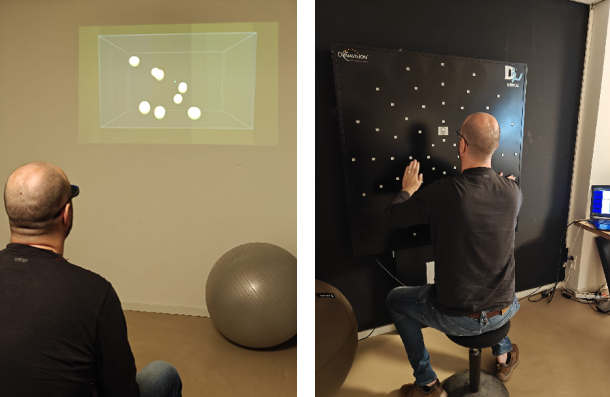
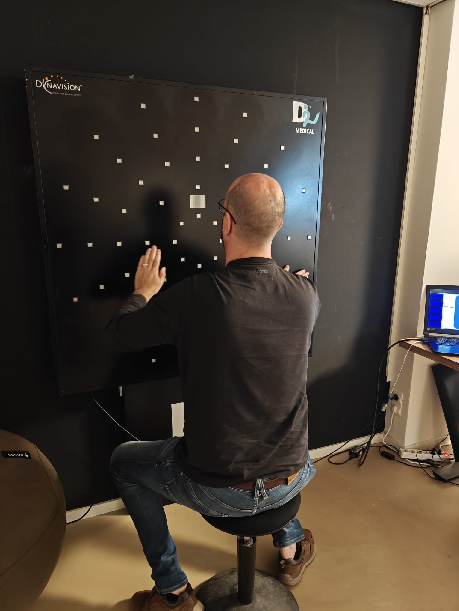
After eighteen weeks, two additional exercises were introduced: NeuroTracker and Dynavision. These are completed once a week at the clinic and are designed to improve the brain’s processing speed by stimulating new neural connections. According to Frank’s clinician, the exercises may also help move the visual snow and floaters further into the background, as the brain learns to prioritise other information.
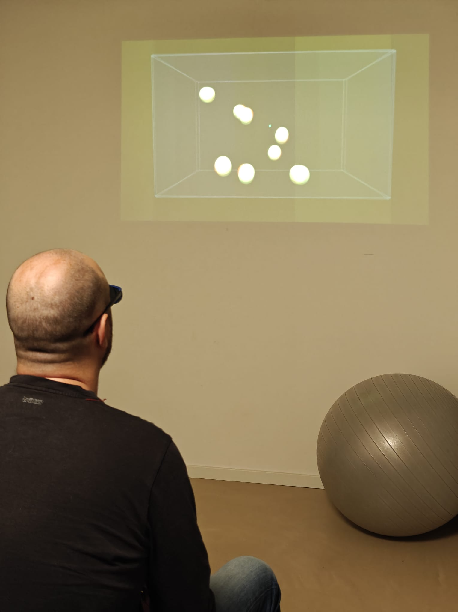
“After these sessions, I often felt somewhat ‘foggy,’ and my sleep was almost non-existent during those days. With NeuroTracker, you wear 3D glasses while looking at a field of moving tennis balls. You have to keep track of the balls and identify which ones were highlighted at the beginning of the exercise (see photo). There are several difficulty levels, and sometimes you also have to memorise additional information, such as a shopping list, while completing the task. Over a twelve-week period, my processing speed increased from 1.3 to 2.9. I still have six weeks of training left, so there may be further improvements.”
Dynavision consists of a board with red and green illuminated buttons that light up randomly. The goal is to press them as quickly as possible. This exercise is designed to train peripheral awareness and reaction speed. Both exercises resulted in measurable improvements in processing speed. However, Frank also experienced mild headaches and insomnia for several days afterwards.
Did it help?
“I noticed that I process sensory input much better, particularly in busy public environments. I also find it easier to absorb new information at work. Unfortunately, my visual snow itself and my tinnitus have become worse, although this may be a temporary effect related to reducing my medication. I have therefore not experienced any improvement in those symptoms. My perception of floaters has also remained unchanged.
Personally, I am glad that I completed the programme. The improvement in sensory processing has helped me in family life, at work, and in social situations. At the same time, it remains an expensive treatment if you have to pay for it yourself. My experience is, of course, entirely personal, and I cannot say whether this treatment is suitable for others or whether they would experience similar results.”
Frank’s experience with vestibular therapy
“When my Visual Snow symptoms first began to develop, it started with floaters. A few months later, it felt as though my vision was moving, as if I had drunk half a crate of beer. I also noticed line patterns vibrating and overlapping each other. I underwent an MRI scan and saw an ENT specialist, but nothing abnormal was found. The MRI was normal, and no further action was taken regarding my symptoms.
After discussing my symptoms with my GP, vestibular therapy was suggested. This therapy is provided by specialised physiotherapists and involves training for approximately five minutes, three times a day. The exercises are simple to perform at home.”
Example exercises
1. Eye and head coordination
- Place two sticky notes with a dot at eye level on a wall, approximately 30 cm apart, and stand about half a metre away.
- Move only your eyes from one dot to the other without moving your head.
- Once your eyes reach the dot, smoothly move your head in the same direction.
2. Smooth pursuit exercise
- Hold your thumb up approximately 50 cm in front of your face.
- Move your thumb in random directions.
- Follow the movement using only your eyes while keeping your head still.
3. Increase the challenge
- Perform the first exercise against a visually busy background, such as a checkerboard pattern, or while standing on one leg.
Did it help?
“For me, yes. Within a few weeks, my vision felt much more stable. Again, this is purely my personal experience and does not indicate how effective it may be for others.”
Frank’s experience with FL-41 glasses
FL-41 glasses are often mentioned as one of the first supportive tools for people with Visual Snow. However, not all FL-41 glasses are the same: their quality varies considerably, and they do not work for everyone. In some countries, colorimeters are used to precisely determine which filter works best for each individual. Frank explains that he has not yet been able to find this option in either the Netherlands or Belgium.
“After contacting several optometrists, I have not yet found an option for prescription FL-41 lenses. Prices for FL-41 glasses range from approximately €40 to €170, and not all models are suitable to wear over prescription glasses.”
What are the differences between FL-41 glasses?
“First of all, not every FL-41 model is suitable as an over-glasses fit. In addition, there are significant differences in filter quality. Broadly speaking, there are three shades:
- Light pink — mild filter
- Medium pink — standard FL-41
- Dark pink / red — stronger filter, which can sometimes be too intense.
The brain responds differently to these shades. Some people actually experience more visual noise when using a stronger tint, so it is important to determine which works best for you.
The original FL-41 tint primarily filters light within the 480–520 nm (blue-green) wavelength range. Many lower-cost glasses simply use a general pink tint that does not effectively filter these wavelengths. Light transmission also varies considerably: some lenses allow around 80% of light to pass through, while others allow only about 50%. There are also glasses marketed as ‘FL-41’ that simply have a cosmetic pink tint without using the genuine filter.
It is also worth remembering that light plays an important role in regulating the body’s sleep-wake cycle. For that reason, wearing FL-41 glasses throughout the entire day may not be appropriate for everyone.”
Other differences between FL-41 glasses include:
- the level of polarisation;
- the presence of an anti-reflective coating;
- the number of filter layers.
Visio
“At Koninklijke Visio* (depending on the location), you can borrow a pair of Multilens FL-41 glasses for one week to try them out. I eventually decided to purchase a pair myself. They do not directly reduce my visual snow, but they do reduce my sensory overload. This is particularly helpful when trying to fall asleep. I wear them while working and when watching television.
Again, this is only my personal experience. FL-41 glasses do not work for everyone, and the degree of benefit varies from person to person. If you are considering trying FL-41 glasses, it may be worth asking whether a trial period is available before purchasing a pair.”
*Koninklijke Visio: a Dutch organisation specialising in visual rehabilitation and support. Although VSS is a neurological condition rather than an eye disease, some people with VSS may benefit from advice on visual aids or filters to help manage certain symptoms.